

I pushed open the café’s glass door and stepped back out into the depths of February. The warmth, light and bustle of people were sealed behind me by a soft, obedient click. A brief wisp of warm air still clung to my coat, like a polite hand reluctant to let go. Then the cold enveloped me. It did not strike. It waited. Patiently, persistently, with a determination that seemed almost tender in its precision. First it found my most sensitive spots: the skin on my wrists, the shallow hollow at the base of my neck. Then it crept into my sleeves and along my spine. There it settled patiently.
Just a few moments ago, I was sitting opposite him at one of the small, functional tables with clean-cut edges. They looked modern and understated. Designed in such a way as to politely keep our bodies at a distance from one another. The cups stood between us. Two men, arranged geometrically. Almost two years had passed since I last saw him. Something commonplace moved between us, something that paid no heed to greetings. We spoke quickly. Time was short. The place allowed for no slowness. And we didn’t need it either. The surfaces were too smooth, the light too precise, the air too neutral to hold onto anything that hovered between our words. We spoke about where we’d been at that time. But not in any way that was meant to be repeated. The endeavour – as we called it with a faint smile – was behind us. But was it over? At that time, each of us was doing what, in secret, was meant to help bring it about. We were both here. The same place, the same time. That alone was a shortcoming. If everything had gone according to plan, this coffee wouldn’t have happened. Had the invisible cogs turned as intended, there would have been no reason for us to be sitting opposite each other like two travellers on the wrong train. I told him my interpretation. I listened to his. The sentences met, bowed to one another. Then they passed each other by without touching. We both heard the gaps, the inconsistencies. We knew that corridors and planes were missing between our narratives. Something wasn’t working in that distant city, where the story breathed differently. We left everything as it was: a remnant, a scent that didn’t belong to the room we were in. Then we said our goodbyes.
Now, standing outside the café, that smell reminded me of a different density of the air, of a different way in which the world once pressed close against me.
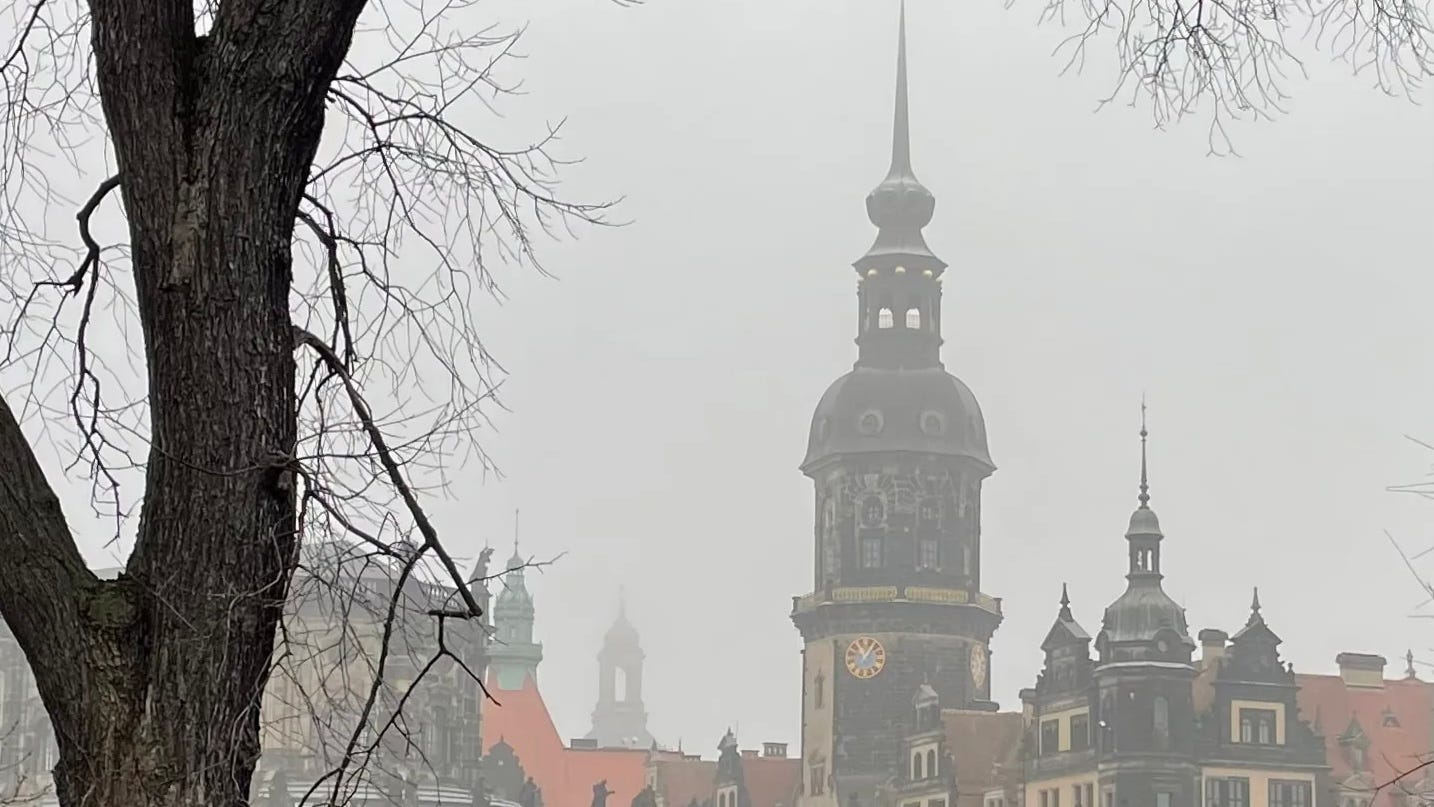
But these lingering echoes belonged to a different snapshot in time. Now Dresden awaited me. And I took a deep breath. The air had a faint taste of metal and damp stone. The streets were pale. The surroundings were smoothed into gentle contours. Behind me, the café hummed with its clean, modern steadfastness. Steel, light, hushed conversations, the obedient hiss of a machine preparing yet another cup. It was already beginning to feel unreal, as though I’d merely imagined it. I paused beneath the narrow canopy and let my eyes adjust to the colourlessness of the late afternoon. The sky was not quite white and not quite grey. It was milky, translucent. The façades opposite were softly focused, their lines subdued. Dresden was breathing out. The paving stones at my feet glistened as if a secret pulse dwelled within each one. The damp had darkened them into subtle mirrors. They reflected the blurred façades, the dull mist and the occasional figures passing by. And then, carefully, they returned them, softer and gentler, to their originals. As I set off, my footsteps sounded muffled. Everything was wrapped in cotton wool so as not to disturb the listening surfaces. I found myself in the collected silence of the Old Town.
The air was cold, sharp, invigorating. It brushed my cheeks, resting briefly on my face. Every breath penetrated me like a slow but decisive announcement, opening up hidden spaces in my lungs and chest. The mist softened the city’s outlines. The towers lost their shape, transforming into mere hints. The sky, arching thinly over the colourless buildings, wrote dark calligraphy with the bare branches of the trees. Line by line, something emerged that I could not decipher. But the gesture felt intimate, as if the city were becoming aware of itself. I walked beneath pale façades, their ornamentation worn down by the centuries. Faces, weathered into abstraction, glistened faintly against the hanging damp. The streets drew closer together and then opened out once more into the familiar expanse of Neumarkt. The square lay still; the fog made its vastness seem almost intimate. In its centre, the Frauenkirche rose into the whiteness with its large, pale structure. It dominated the square. The buildings all around it leaned slightly inwards, as if listening to it. Its dome seemed almost organic, like a deep breath held just long enough to become briefly visible. It was like muted gold against the pallor of the day. A few people moved fleetingly at the edge of the square. I made out their silhouettes. Their footsteps were completely swallowed up by the grey haze. A bicycle must have passed by somewhere out of my sight. Its sound was as fleeting as a thought. I crossed the square and strolled through narrower alleyways. The old town enveloped me once more in its gentle embrace. The shop windows were dark, their displays hidden behind a cold layer. Somewhere, something sweet was being baked. The scent reaches me faintly, yet unmistakably. Yeast, sugar and the toasty edge of warmth. It slipped into the mineral chill like a fleeting touch. I follow this warmth for a few steps. Then I let it go again. Figures, muffled by the mist; interiors, invisible yet present, appeared and vanished once more. Air, sealed within walls. Corridors harbouring warmth. Cracks in the walls whispered secrets: moss and shadows, trapped within walls that have seen generations pass by. My footsteps echoed more distinctly for a few paces, then sank once more into the muffled silence of the city. The architecture, ornate yet quiet, bore tiny droplets of moisture like delicate jewels. The buildings stood there, low in contrast and almost empty. Fountains were silent. Their stones were coated in winter.
The city loosened its grip and began to level out towards the river. I followed the slope and let gravity pull me forward. Beneath the sharp bite of the cold, another realm hummed – cold stone, slow-moving water and distant leaves being torn away by the wind. I sensed an ancient rhythm, older than all the streets of this city, a movement that had never learnt to be still. I breathed more deeply. Not out of necessity, but out of curiosity. The space opened up even before the view cleared. The smell changed. The damp became denser and heavier, permeated by a faint scent of iron – old gates breathing rust, hinges that remembered hands. The Elbe made its presence felt without asking to be seen. When the space finally opened up and the river lay exposed, it felt less like an arrival and more like a quiet realisation. There was no threshold to cross, just a gentle yielding. The mist hovered just above the surface. It was a thin, luminous breath. The river was alive. And it was asleep. It drifted along and reshaped itself, without ever disappearing entirely. The current revealed itself only in fragments. Where the faint light gathered, it folded the washed-out day into its rippling skin. Waves glistening with a faint silvery sheen appeared and dissolved again. In other places, the water remained dark and opaque. In its reserve, the Elbe allowed only a few things to be guessed at. As my gaze rested on the water’s surface, I felt my own pace slow and my attention sink deeper into my body. Small stone barriers on the bank, darkened by time, had absorbed moisture, memories and the touch of hands. Their edges had now been worn down by the weather. They seemed less like boundaries and more like pauses. The air there was cool and heavy. The water murmured gently against the stones – a distant echo of movement. Everything felt as though it were suspended, held in a lingering moment, just before something momentous was about to happen. I felt no urge to cross the river. Instead, I remained within the sprawling embrace of the old town, whose streets and walls stretched out behind me like a familiar back. I let the Elbe flow alongside my steps. It was close enough to feel and far enough away to remain untouched. We moved together, side by side. Each retained its own depth, its own direction. For a while, we were connected by the same, leisurely rhythm.
Some time passed. The path along the bank was almost deserted. In the distance, figures moved, only to fade back into the mist. The background sounds were sparse: the subtle, steady murmur of the water, the faint clink of something metallic in the distance, the soft rustle of my coat as I walked. All splendour was reduced to a quiet hint. Nothing imposed itself. Everything seemed content to be only half-recognised. Trees lined part of the riverbank. Their branches stood out against the milky-white sky. The same dark calligraphy repeated itself in endless variations. The roots were hidden, yet within sensitive reach. I could feel them holding fast to the earth. The scent of damp bark and wintry leaves rose faintly. It enveloped me like a soft, earthy whisper. Earth, winter, the slow sweetness of decay. It rose to meet me and settled somewhere deep within me. A couple walked past me, their figures merging into a single silhouette. Their heads were tilted towards one another. Their voices were inaudible. Then they were gone again, and all I could hear was the wind.
After a while, I left the river behind me. The old town surrounded me once more. The streets grew narrower. The mist thickened in patches. The city receded. Towering buildings, their mass darkened, their presence grounding. The cobblestones beneath my feet stretched out. No one passed by any more. The already faint daylight grew weary. Weakly, it withdrew from the façades. Colours faded into silence; contours blurred even further. A pale, grey haze settled over everything that had only just been recognisable by its outlines. One by one, lamps came to life in the windows. Small, tranquil squares of warmth, enclosed embers that coaxed a final, faint glow from the walls. The day had decided to slip away. As I walked, the twilight deepened. The silence grew denser. Everything retreated and vanished into the mighty darkness.
I stopped. The frost had hushed the city, as if someone had draped a cloth over Dresden. My hands went numb. I put them in my pockets. The city seemed both unfamiliar and familiar at the same time. Dresden was silent, but it was not an empty silence. It was full of hints.
The walk back to the hotel seemed shorter. Warmer. The memories of the café began to fade. We knew our thoughts were revolving around the same uncertainty. Yet everything lost its detail. Things receded into the background.
The end of the evening drew nearer. Otherwise, no end awaited me. Just another continuation. Silent and open at the same time, like a road that forgets its direction in the snow.