

Deutsche Übersetzung hier.
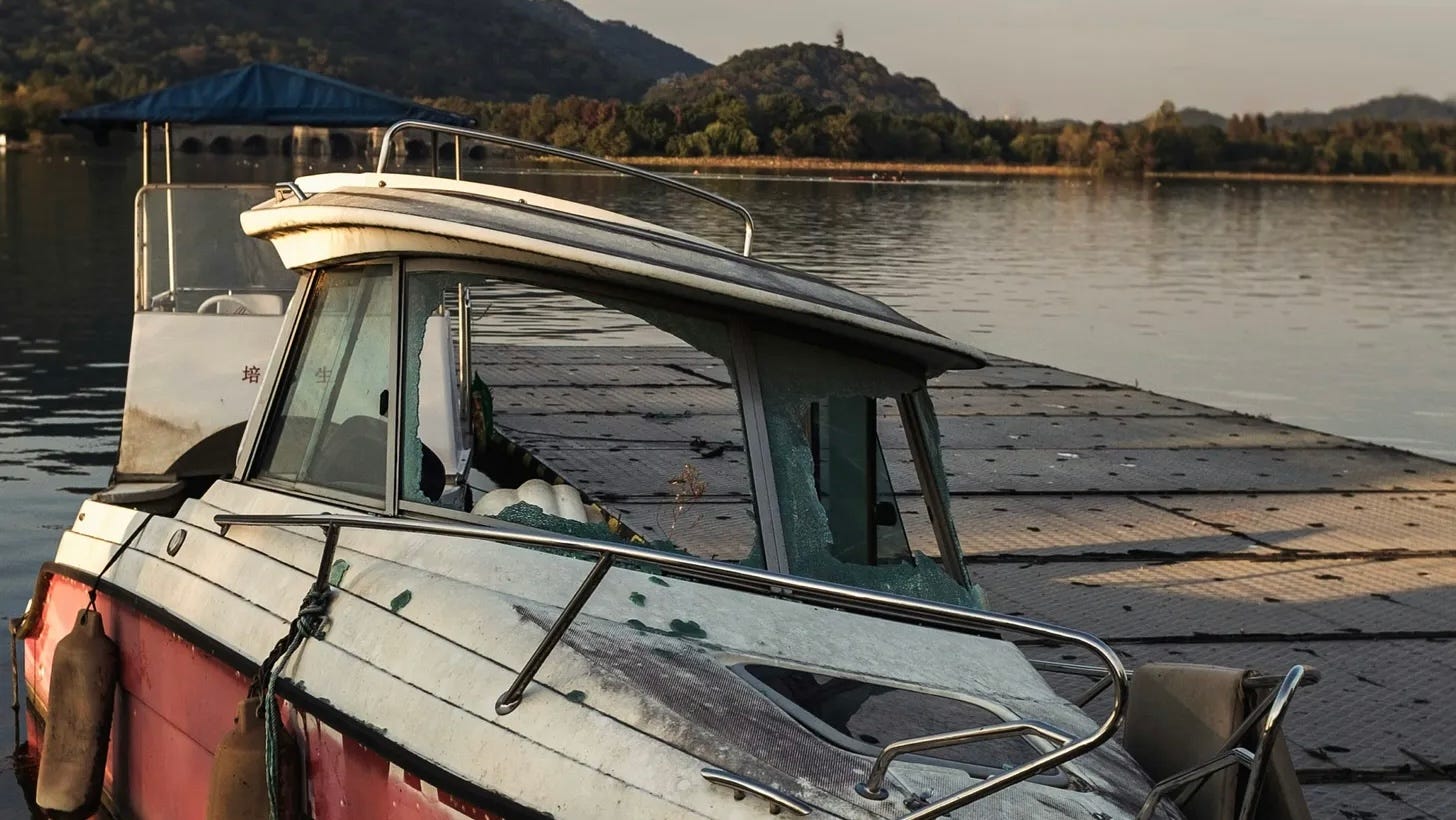
The name was pronounced with a care that stood in no relation to its importance. People didn’t just say ‘the lake’. But Lake Couchiching. And it seemed as though the correct articulation created a sense of affiliation that would otherwise not have been granted. I took note of this and left it at that. In any case, the lake was not merely our destination that day. It also became our destiny.
We set off early in the day. It was a red SUV. To me, as a European witnessing this spectacle as an intern, it seemed enormous. It was big enough to convey a sense of importance to every passing bystander. It was plastered with the broadcaster’s logo, which made it clear even from a distance that something was being produced here that would later be considered relevant. Or it would have to be. After all, we were broadcasting nationwide! Everyone was expected to see this. Inside the car, there was a colourful assortment of cables, bags and that seasoned composure that people acquire when they’re on the road a lot and therefore assume that things will somehow sort themselves out. I was sceptical, but at that point still inclined to believe it.
The breakdown came early. I should have thanked it. Because, in retrospect, this incident gave the whole day an almost educational quality. It wasn’t dramatic. More like a brief interruption in the flow, which was resolved with the same casualness with which it had previously been ignored. Someone lifted something open, looked important, tugged at a few cables, spoke two or three sentences that suggested importance but didn’t really say much. Then something was closed again and we carried on. No one seemed to see any meaning in it. Any at all. Neither did I. Not yet.
The lake lay there like a promise, I didn’t question further. Water surfaces have a habit of being immediately regarded as significant, even if they do nothing more than simply exist. Lake Couchiching made no use of this apparent importance, but clearly benefited from it. Nothing was happening there. It was the same every day. And that day was no different. But the programme had to be filled. And so even the smallest of trivialities eventually seemed significant enough to become the story of the day.
The boat was medium-sized, uncovered, and fast enough to create the illusion of momentum without relying on even a hint of elegance. The driver seemed to be familiar with the area. In this context, however, that meant less that he actually knew his way around, and more that he saw no reason to doubt it.
The interviewer was dressed appropriately. Not excessively, but with a clear intention to be perceived as a crew member with authority on the boat. Someone who, if necessary, could return to solid ground at any moment – while appearing confident. A jacket, shirt and trousers that gave no cause for criticism. He had made an effort. I could see that clearly. And one expected the circumstances to behave accordingly. But the circumstances hadn’t heard of any such thing. So we boarded the boat one after the other. From a distance, this might well have resembled routine. Yet there was never one. Because for a moment, the picture of a well-coordinated crew emerged. And that was it. Discrepancies were easier to spot in hindsight than in the heat of the moment.
At first, everything unfolded as a controlled movement that was easy to film. The boat glided along. The lake pretended to cooperate. And the interviewer began talking to the camera as the boat was still moving. It was that moment when someone decides the situation is now mature enough to be captured on film. But in truth, it was on the verge of becoming complicated. A voice said we could go a bit faster. Not a suggestion. More of a casually phrased instruction, delivered with the confidence of someone who expected even the laws of physics to comply with his assessment. The driver reacted immediately. In my opinion, he didn’t want to be reproached later for having missed an opportunity to improve. The boat picked up speed. The surface of the water became more turbulent. No one objected. In such moments, speed is rarely seen as a risk, but rather as a sign of quality.
The interviewer was already speaking. I could tell from his expression that he was concentrating on maintaining control – of his voice, his posture, his clothing and his choice of words. It was a polished, professional effort, based on the assumption that the surroundings would fall into line with this plan. But suddenly, they refused to.
The impact was not a single event. It was a brief series of corrective manoeuvres, all of which came too late. The boat ran over a huge rock that lay just below the surface, watching the day’s events unfold. It lost contact with the water. Completely. The illusion of mastery was gone. The boat lifted, as if it had wanted to formulate its own objection. A moment later, it returned to the water with a decisiveness that did not fit the situation up to that point. Nothing was in its place any more.
The camera was the first to disappear. Without any pretence of significance. Rather, it was a logical step. It had realised that, given the circumstances, it would no longer be able to fulfil the task assigned to it. Some of the equipment followed it. Less convinced, but just as resolute. The cameraman stayed behind. At that moment, I found this to be little consolation. The interviewer briefly and violently lost his footing. He did not find himself in the same position again. Water did the rest. It wasn’t much, but enough to disrupt any sense of sovereignty. His jacket was soaked through. Ambition had deserted his shirt. The entire set-up, which just seconds earlier had been taken for granted, suddenly seemed like a misunderstanding.
The driver clung to the steering wheel, gripped by a mixture of fear and perplexity. Distressed, he switched off the engine. The boat did not move. This kind of silence is not tranquillity, but rather a temporary suspension of excuses. No one said anything worth remembering. They looked at one another. Neither accusingly nor understandingly. It was the look of people who realise together that they had made a mistake, without having yet decided who was to blame.
The return journey to the shore was slower. Not out of prudence. Speed had lost its appeal for everyone involved. Once back on shore, the question of clothing arose. After all, the interview had to be finished. The interviewer had brought nothing to change into. This had less to do with an oversight. It seemed more an expression of a fundamental trust in the stability of this world. Yet that trust was now visibly damaged. He took off his jacket, looked at it briefly, as if it might explain itself. Then he decided against waiting for that explanation. What remained was a T-shirt.
He was angry. Yet in a way that couldn’t be fully expressed. The situation was too trivial to really let it escalate. But also too unpleasant to simply ignore. So he spoke in a tone that made it clear something wasn’t in order, without any consequences having been drawn from it yet. Then they filmed. With a small replacement camera. He stood in front of the lens, now in a version of himself he hadn’t intended. He spoke the lines that were apparently still deemed necessary. I could see he was trying to restore a sense of professionalism. But he lacked the substance that usually underpins this kind of composure. The lake lay in the background, behaving as if nothing had happened.
I can no longer remember what the subject of that piece was. Even back then, it seemed to me like a detail that wouldn’t hold up in the context of the story. What remained was the brief, very precise realisation that a situation cannot be stabilised simply by declaring it to be stable.
Incidentally, the name of the lake was always pronounced correctly.