

Deutsche Übersetzung hier.
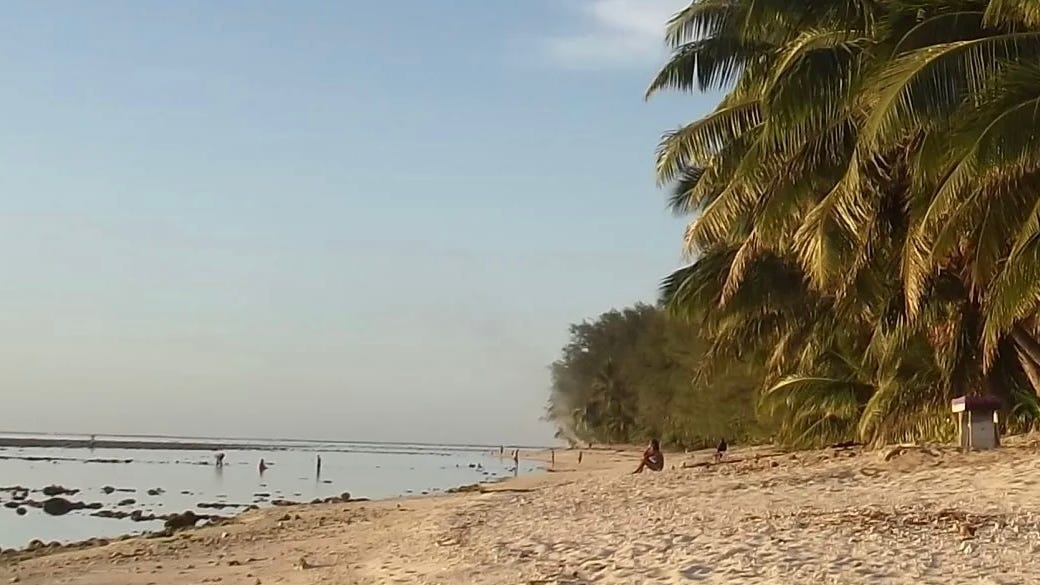
The beach
The sand was warm beneath me, dry and fine on the surface. Beneath that, it was cool and firm. When I dug my fingers in, I reached the damp layer that smelled of the sea. The sand slowly fell back and filled in the trace of my hand. The heat hung over the beach. The air shimmered and the contours became blurred. A flat gleam lay on the light sand. The dark lines of seaweed on the shore had soft edges. Even the shadows moved slightly. The light fell harshly on the sand, stones and shells. It allowed for little depth. I narrowed my eyes.
Further out, the sea lay calm and steady. Where the swell broke, it became bright. The air shimmered along the water. The horizon did not appear solid. I sat on my sheet and looked into the sun. With my eyes closed, the light remained red behind my eyelids. The brightness of the day was apparent. The heat persisted.
The coconut palms stood behind me in a loose row. Their trunks were tall and slender, grey and ringed with old leaf scars. Further up, they bent slightly in the steady wind. Some leaned towards the sea, others stood more upright. As long as the air was still, they hardly moved. When the wind picked up, the long, narrow leaves lifted and brushed against each other. A dry, steady rustling sound arose and ebbed away again when the wind subsided. It came in calm gusts, not strong, but steady. I could see it running across the water. Darker streaks ran through the bright blue and rippled the surface. Small waves ran across the swell and lost themselves on the beach.
As the wind grew stronger, the leaves bent further and the rustling became louder. Individual dry leaf tips clattered against each other, hard and short. Sometimes a fibre came loose and fell onto the sand. Nothing moved on the trunk. The air was warmer there, and the shade smelled of wood and dry dust. The wind brushed over my skin and dried the sweat. When it eased, the sound of the surf remained, and the leaves hung still until the next gust came.
When I looked out to sea again, I noticed movement far away on the horizon. At first, it was just a dark line in the shimmering light. I wasn’t sure if it was really there or if it was just a reflection of the flickering air. I kept my eyes fixed on it and squinted. The light fell brightly on the water, and the glare repeatedly dissolved distinct shapes. More than once, I wanted to look away. Then the movement rose again from the swell. Slowly and steadily, heavier than the waves.
After a while, individual shapes emerged from the light. Several surfaces rose one after the other and then disappeared again. They were whales, far out at sea. Sometimes a dark back appeared above the bright surface, then only sea again. Once, a small fountain rose and disappeared into the light. They passed by at a distance from each other and became smaller in the shimmering light. I remained seated and looked out until they were no longer visible.
Finally, I stood up. The sand slid off my legs, and I brushed it off my hands. The heat lay evenly on my skin. For a moment, I stood still and listened to my breathing and the sound of the surf. My eyes followed the direction to the small harbour.
The path
The path was flanked by hibiscus. Red blossoms lay in the light on the green. Some were still open, their edges slightly curled. Others lay in the dust, their colour darkened. Birds sang among the bushes. Short, clear notes that hung in the warm air and then faded away. I walked slowly. The ground of the path was trampled and covered with sand. It was lighter in the sun, darker and cooler in the shade. The wind had drawn narrow lines in the sand. It smelled of earth, resin from the trunks and salt from the sea.
The heat remained. The wind grew weaker. The shadows of the bushes stretched to the path. I stopped and listened. Behind me was the sea, muffled by the plants. In front of me was the chirping of insects.
Then I continued on, step by step, over a small hill from which I could see the small bay and the harbour. It was protected by coral reefs. The water seemed calmer there. Only when I looked longer did I recognise the raising and lowering again. The blue was brighter. In the shallow areas, I could see the sandy bottom. The waves rolled in and out slowly.
The boundary between sea and sky was barely visible in the haze. I paused for a moment and looked across. Small boats were moored in the bay. At first they seemed motionless, then I saw them swaying slowly on their lines and the shadows beneath their hulls. I breathed in the warm air and continued on my way. With every step I took the bay came closer as I followed the narrow path between low bushes and scattered palm trees down to the wooden piers.
The boats rocked in the bay. Their sails hung loosely in the light breeze. An old wooden boat lay moored next to a new dinghy with fresh paint. The wood of the old boat was grey and cracked, split at the edges. In some places, the salt had left a light-coloured crust. The planks were uneven, with dark lines from the water between them.
Everything lay quiet in the small harbour. The air was almost still. Only occasionally did the wind brush across my face. I heard the creaking of the planks, the thumping of the ropes against the masts and the clattering of a loose block in the rigging. Every now and then, a rope would tighten and then loosen again. Wood rubbed against wood. Sometimes two hulls touched and then separated again. An irregular metallic ticking came from one boat, as if a ring were striking the mast.
The water pushed against the piers and receded. I tasted salt on my lips.
The wood there was bleached by the sun. In some places it was worn smooth, in others torn apart. A frayed piece of rope hung from a post, hardened by the salt, barely moving in the wind. I could see the water between the boards. Sometimes a strip of light fell into it when a small wave hit the posts.
Small fish stood still in the shadow of the beams. Occasionally one darted to the side. Shadows glided past and disappeared again. The light refracted on the water and wandered across the wood.
The bar
I went to the bar. It stood slightly set back at the end of the wooden piers. It was a simple structure made of bamboo and wood, in the shade of a large palm tree whose trunk leaned over the roof. The palm leaves rustled in the wind. The walls were not quite straight, the wood darkened in many places by rain and sun. Some boards had warped. Between them were narrow gaps through which the wind blew.
The building was weathered. Seating was provided in the shade under a canopy of lianas. Behind it lay the sea in the late afternoon light. The smell of grilled fish and rum mingled with salt. Dishes clattered. A voice spoke and then fell silent again. Sporadically, a strip of light fell through the walls and wandered across the floor.
I sat down at the bar made of rough wood. The surface was faded. I ran my hand over it and felt unevenness, small splinters and places that had been smoothed by many hands.
I ordered white rum with lime juice. It had to be dry and strong. The man behind the bar nodded and moved slowly. He took a glass and cut the lime on the wooden board. While I waited, I looked at the boats. From here, they looked smaller. Their rocking was barely noticeable. The masts drew fine lines against the sky, which was becoming paler.
I smelled salt, wood and smoke. For a moment, there was silence. Then a rope hit a mast, and the sound carried across the water. When the glass was placed in front of me, it fogged up in the warm air. Drops formed on the outside and ran down. They gathered at the bottom of the glass, leaving a dark ring on the table.
I picked up the glass and felt the cold through the wet surface. I drank. The coolness spread in my mouth and went down my throat. I put the glass back down. It clinked softly on the wood.
Outside, the boats barely moved. The contours beneath them became blurred and the colours darker. The ropes hung loosely. Occasionally, wood creaked against wood. The water grew quieter. I leaned back and let my gaze wander across the bay. The horizon now lay clearly above the water.
The light grew weaker. The shadows merged into one another. Twilight set in. The day lingered in a narrow band in the sky. The wind was warm, but cooler than before. Muffled voices came from the bar. Glass clinked somewhere. The sounds hovered over the water and faded away.
A woman sat down next to me. Her long hair was tied back in a loose braid, with individual strands blowing in the wind. The white linen of her dress caught the last rays of light. Her gaze rested on the sea. She looked out for a long time without saying anything.
Then she turned slightly towards me and smiled. “In the evening, the sea becomes ever quieter,” she said, raising her glass.
We were silent for a moment. She looked out again.
She said she often came here. The sea gave her peace. The stars above the Pacific were her point of reference when she was outside. Her gaze remained fixed on the water.
I told her about my travels. About cities in the heat. About the light on walls, dusty courtyards and flat roofs that still gave off heat in the evening. About the wind leaving traces in the sand and the silence of vast plains. As I spoke, a loose line hit a mast somewhere.
Then she told me about the early mornings when she would set sail on her yacht before the island awoke. The boat would leave the pier. Ropes would creak, wood would bang against wood. The engine would run briefly, then she would set the sail. It would rise and fill with wind. The water would run along the hull.
She spoke of nights at sea, when the island lay behind her and could only be seen as a dark line. The sky was clear and the stars were close together. Beneath the boat, lights sometimes appeared in the turbulent water.
We talked for a long time. During the pauses, we realised that we were looking for similar things. Vastness. Silence. The feeling of losing oneself in something bigger. Just space.
Twilight deepened. The light on the horizon narrowed and turned grey. The palm trees stood dark against the sky. The first stars appeared. Then there were more. The sky became wider and darker. The sea took on the colour of the night. A thin transition remained between the two.
We were silent. Far out, a deep sound could be heard. It could have been a whale or a wave. It was impossible to tell.
The pier
The bar emptied. The bartender placed chairs on the tables and wiped the counter with a damp cloth. The room now lay in dim light. A glass clinked once more. Then it was quiet. She put down her glass. A thin ring of water remained on the wood. “They’re closing,” she said.
We stepped outside.
The piers lay ahead of us, long and dark. We stepped onto the main one. The water between the planks was black. It barely moved. Only a slow rise and fall could be felt. The wood under my feet was still warm from the day. But the coolness came up from below.
We took a few steps further out. The bar was behind us. The light above the door cast only a faint glow on the first few planks. Beyond that, it was grey. The poles stood like shadowy lines in the water. A rope lashed against a mast at regular intervals. The sound was dry and steady. She stopped and placed her hands on the railing. I stood next to her. The wood was rough under my fingers. Salt had left light-coloured marks that shimmered dully in the moonlight.
The wind was weak. It moved the surface of the water in long, lightless stripes. Between the boats, the moonlight glided narrowly across the water and broke on the hulls. Once in a while, a boat bumped quietly against a fender and moved away again.
“It’s quieter now,” she said.
We leaned side by side against the railing. Our shoulders touched as a small wave passed under the pier. Neither of us stepped back. Below us, the water lapped against the poles. The noise was hollow and regular. Out in the distance, a boat slowly turned on its mooring line. You could hear the soft creaking of wood. Above us, the stars were clear. The moon was reflected between the piers.
She looked out at the night water and stood still. Any movement would have disturbed the moment. The wind blew a strand of hair out of her braid. She left it as it was. We stood like that for a while. The boards beneath us continued to cool. The air smelled of salt and the wood of the planks.
She let go of the railing and walked towards her boat.
Then she looked at me.
“Come.”
The sea
Her boat was moored where the dock met the open water. The bow line stretched in the light breeze and then relaxed again. The cleat glistened in the moonlight. She climbed in first and held the boat steady. I followed. It swayed briefly and then lay still again. A creak ran through the hull. The rope was rough and damp. The knot was tight. I pulled it loose. The fibres gave way. She put the line in the cockpit and turned the ignition key. The engine ran smoothly. Petrol mixed with salt.
We glided out of the bay. The lights behind us grew smaller. A narrow strip of moonlight lay across the water. With every wave, it broke and closed again. Once we were out, she turned off the engine. The noise fell silent. She went to the foresail, untied it and pulled on the halyard. The rope ran through her hands. I grabbed the rudder. The sail rose slowly and filled with wind.
All that remained was the water and the quiet working of the lines.
The boat tilted slightly to one side, almost imperceptibly. The wind came from port, steady but not strong. We sailed out at a shallow angle. The shore became a dark line and disappeared. The smell of land faded away. Salt remained in the air. The sail stood calmly.
A slow swell passed beneath us. No breaking, no foam. Just a rising and falling. The wood beneath my feet transmitted the movement. A longer wave came at an angle. The boat tilted more sharply. She placed her hand on my forearm. Her fingers remained there until it levelled out again.
The moon was higher in the sky. Its light fell on her face. The water was dark. When the bow parted it, it slid apart. A soft hissing sound remained. She moved closer and leaned her shoulder against mine. I could feel her breath.
She said something quietly. I put my arm around her, not tightly. She laid her head on my chest. I heard the fabric rubbing. The boat held its course, the sail stood, and the water continued to flow beneath us. Then, we were silent as the boat moved through the waves.
After a while, she turned her head towards the horizon. The blackness there was no longer even. Soon the first light would appear. She pulled the foresail tight and lowered it. The cloth fell into folds. I helped her fold it up. The fabric was cool from the dew.
She turned the ignition key. The engine started. The sound was rougher than before. We set course for the bay. In the distance, a narrow, bright strip lay across the sea. The stars grew paler. The water lost its blackness.
She sat next to me. The boat rocked gently. As we approached the shore, the houses became visible. The line of land emerged. A bird flew low over the water. A narrow light stood on the roofs. The beach was empty. The sand was flat and firm. Sheltered by the bay, she eased off the throttle. The engine fell silent. The boat slowed down. You could hear the small waves splashing against the hull.
I jumped onto the pier and took the rope. Everything was cool from the morning. She handed me the rope. Our fingers touched briefly. The boat docked. The metal clicked as it cooled. Then she climbed onto the planks. The boat swayed lightly. I held her hand. She took it. Her fingers were cool. She stood there for a moment, one foot in the boat, one on the pier. Then she let go.
We walked side by side along the dock. The wood was damp and smelled of salt. Below us, the water lapped against the posts. The light grew brighter above the houses. The first windows were open. We stopped at the end of the dock. The air was still.
“I’ll be out again tomorrow,” she said.
“I know.”
She looked at me as if she wanted to remember something. Then she turned and walked up the narrow street. After a few steps, she stopped, not completely, just briefly, as if she had forgotten something. Then she continued on her way.
I waited until she disappeared behind the houses.
The light grew brighter.
Everything lay still in the harbour.
Photo by Brooke Staz on Unsplash